However much you may dislike it, you cannot alter your caste now(1)
– Except from the Indian poem Mahabharata, dated to approximately 2nd century BC.
May 22nd 2004 marked a significant point in India’s history, when it announced to the world, and its own 1.1 billion strong population, that it embraced all religions and castes equally. With a Sikh Prime Minister, a Muslim President and a foreign-born Roman Catholic President of the ruling party, India was displaying in one political moment its equality and love for all of its children, regardless of caste, colour, creed, or social background. India’s claim to be being the worlds largest Secular state was seemingly, politically at least, confirmed with aplomb. This idyllic scene of ‘Mother India’(2) is a common ideology portrayed to the populous, but how does society itself react within this realm?
How is a Secular India, whereby people from different religious and caste backgrounds, practiced within physical space, and how do specific spaces allow for this? The image portrayed is that of different people from different regions coming together, regardless of background, to form a united front. The Indian parliamentary and ceremonial hierarchy suggests one facet of this example.
However, Secular India, like any country, is a fractured state. Space is divided into political regions and further into separate inter-cultural identities. With its vast population, it cannot be stated that the populous is distinguished as a mono-socio/economic entity. What was whole is still whole, but its surface is cracked to show differences, and texture which is faceted. Like any other country and region, but more so in India, social division occurs based upon wealth, education, geographical region, and of course, religion.(3) Further, this stratification of society is amplified in India when one takes into account the highly political, yet antiquated, system of caste and class division within the dominant religious grouping– the Hindus.
The Caste system, as portrayed in myths and legends, and which forms the basis of Hindu ideology, still commands with and air of utter and unrelenting dominance within 21st century India. Centuries of colonialism, both political and now commercial, civil unrest, and the introduction of the nuclear age have done little to dilute the staunch hierarchy within the world’s second most populous nation.
This ordering device forms a patchwork throughout India, none more so than in the city of Varanasi in the eastern state of Uttar Pradesh. Commonly referred to as the ‘Eternal’ Varanasi, the city is claimed to be the oldest living city in existence. It finds mention in the epic poems Ramayana and Mahabharata, which have been approximately dated to 4th century and 2nd century BC, and is a cultural epicentre for India in terms of its historical heritage, the Hindu and Buddhist religions, architecture, the arts, and thus predictably, international tourism. The city has been a centre of learning for over 2000 years, and it was at Sarnath [approximately 10km north of Varanasi] that Buddha first preached his message of enlightenment 25 centuries earlier. Thus, for the pious Buddhist and Hindu, this city has always been an important pilgrimage destination(4), yet it holds further social significance in that it is deemed by Hindus as a ‘holy’ space.(5) All are welcomed and embraced by the river, regardless of social standing or caste.
Social space, and thus the space of Varanasi, is informed by the inhabitants and users of space, and space is therefore forever shifting as different bodies with differing narratives move through it.
The city always had relations with society as a whole, with its constituting elements [countryside and agriculture, offensive and defensive force, political power, states, etc], and with its history. It changes when society as a whole changes. Yet, the city’s transformations are not the passive outcomes of changes in the social whole. The city also depends as essentially on relations of immediacy, of direct relations between persons and groups which make up society [families, organised bodies, crafts and guilds, etc].(6)
Space, in an abstract sense, as argued by Lefebvre, may be changing according to the body, but how does the architecture relate to this?
This dissertation will attempt to explore how the highly antiquated, yet contemporary and political, phenomena of the Indian Caste system informs the production and realisation of space in Varanasi.
An extensive amount has been written about the city of Varanasi, and similarly the caste system in India. Benares: The Sacred Landscape of Varanasi, by Gutschow(7), relays a typically romantic version of the history of Varanasi, and its contemporary incarnation. Varanasi: The City of Burning and Learning, by Sharma(8), again provides a ‘beginner’s guide’ to the city, and is written for the tourist as a scholarly accompaniment to their travels. These provide a good introduction to the city, but are not concerned with the population of Varanasi, and their congregation practices. Dumont(9) provides the most extensive account of the caste system and practice in The Caste System and its Implication, but this account does not relate the stratification of Indian society to social space and physical architecture. This dissertation provides an ideal opportunity to examine these two phenomena against a contemporary backdrop.
This dissertation begins by outlining a history of the caste system in India, and the contemporary social ramifications of its adoption, in the chapter entitled Caste and Space. Further, in this chapter a case study will be introduced, together with a methodology to understand this space.
The chapter Dashashwamedh Ghat is divided into three major sub-chapters; The Anthem takes a representation of space, the Indian National Anthem, and explores how it informs a narrative for the perceiver; The Ghat examines how the physical space of the case study site is informed and reformed by its inhabitants with reference to an extrapolated narrative gleaned from a close-reading of the Indian National Anthem; The Tourist introduces another layer of representation and reformation of physical space into the study, and discusses how an examination of tourist activity can further increase our understanding of Caste and physical space.
Finally, Closing Words offers an opportunity for the exploration to pause in breath and reflect upon its findings, and suggest further avenues of study.


As a mass exercise of craft allocation, the caste system in India is a stratified and hierarchical social-economic organisation of society that evolved as India’s ancient civilisations absorbed the nomadic, Sanskrit speaking, Aryan population who passed from central Asia and settled in North India. The ancient Hindus, literally meaning the peoples of the valley of the Indus River, soon took on functions and specialities that had little to do with tilling the soil. Four Hindu castes thus developed out of necessity, for with the evolution of society it was no longer possible for the farmer to assume the functions of priest, warrior, merchant and artisan all at the same time. This new way of social organisation brought with it a need for governance and order. Roles began to be defined and people were classified according to their occupation and economic standing. Thus, Brahmins were to be spiritual guides; Kshatriya became the nobility; Viashya the farmers and merchants; and Shudra included individuals who performed service duties. However, a fifth caste also emerged from under a seemingly perfect display of equal delegation. The ‘outcastes’ or Untouchables became the term used for the group of people who fell outside of the four main castes, and who performed tasks which were seem as ultra degrading within Hindu society; cleaning up after funerals, scavenging, or working with leather or in unclean environments.
Whilst the rigidity of the roles assigned to castes is now largely defunct in contemporary India, the caste system still casts a shadow over social interactions and opportunity. Only Brahmins become priests and can bless others, and it is largely the Untouchable and lower caste communities who provide the workers for the cleaning trades. Cross-caste marriages and relationships are not accepted in the majority of cases, and even touching an Untouchable, or accepting food from their hands, is deemed to be an ‘impure’ act by the higher castes. This stratification from birth, and not from upbringing or education, defines perhaps less social roles in contemporary urban India, but does define in a large part social interaction between citizens.(10)
Social space within Varanasi can be glimpsed at one of the numerous Ghats lining the River Ganges. Translated, the ‘ghat’ is simply a set of wide steps leading down to the river which have become natural space of congregation, religious ceremony, and recreation.
The Ghat opens a unique and poignant backdrop for the theoretical language of space, caste and narrative to latch onto a physical dimension. This is needed, as what is to be studied is nothing without the presence of the social, for the caste system functions within the realms of human interaction. This study will begin to focus upon how human interaction between members of different castes informs/deforms/reforms the function of a particular space. If a notion of the production of Casted Space is sought, how is one to delineate between the spatial characteristics of caste and the space it produces?
Varanasi provides the ideal stage for this study to take shape. It is the focal point for religious pilgrims, the city dweller, workers, as well as domestic and international tourists. Therefore, the River and Ghat act as a social-levelling device for the Hindu populace. Only at these ‘holy’ sites, under the banner of socio-religious space, should the Untouchable be ‘equal’ to the Brahmin. A glimpse of Secular India can be witnessed at the Ghat, where reign is, in theory at least, not given to one demographic of people over another.(11) Is this truly the case, and can a micro-version of a Secular India be witnessed at the ghat?(12)
That the steps function as a physical traversing device is of less importance in this exploration. The architecture and landscape of the ghats carries within it implied function and symbology. However, with the Ghat seen as a ‘holy’ site allayed to its role as a place of tourist destination, this space is elevated from that of a pure container to a patchwork of interrelated meaning and interpretation.
But first, the Ghat should be described and understood as a physical subject before it is explored and examined under the lens of caste representation and subsequent production of space.
Dashashwamedh Ghat [DG], [see Appendix A], or Main Ghat as it is also known, is the most popular and visited ghat of the 80 sets of steps which line the River Ganges as it runs through Varanasi. It is, of all the ghats, the biggest and most easily accessible by car or by foot. It is also the only Ghat which has an advertised twice daily service [Puja(13)] at which hymns are sung and offerings are given in honour of the River Ganges. Not only is it surrounded by temples which display the Hindu Gods in idol form, the River itself is seen as a God and worshiped. The Ghat is surrounded by a particularly large number of budget hotels and cafes – ideal for the backpacker tourist who wishes to be close to the focal point and gathering place of the city.
Although the River Ganges is the focal point of this space, the river and the manner in which people act towards it has allowed for and facilitated the opportunity for secondary points of interest. A religious space is now overlaid with a veneer of commercialism; dotted around the periphery of the ghat are permanent and temporary stalls and eateries servicing pilgrims, be they visitors seeking either spiritual or touristic enlightenment.
The 24hr time cycle of DG can be described as follows (Time/Main Use of DG as an entity):
0500 – 0600: Morning Puja
0600 – 1300: Temples open, utility/food stalls open, morning bathing by lower castes, fishermen start work, general congregating by the middle/lower castes.
1300 – 1900: Temples perform services, fast food stalls open, tourists/guides appear, touting for boat rides, touting for informal blessings by Brahmins, general recreation by Indian middles classes, cleaning of ghat before Puja commences
1900 - 2000: Evening Puja
2000 - 2200: General recreation space for all classes, and temples/shops/stalls close.
2200 – 0500: Space of congregation/sleeping for lower castes/untouchables.
Punctuated by the two instances of charged religious action, the Pujas, the Ghat is a social gathering space for a multitude of people and actions. The ‘holy’ River is ever present, and it is ultimately the sole reason for this activity. Outside of the organised Pujas, the Ghat becomes a place of informal blessing by local Brahmins on their mini platforms, of occasional games of cricket, of vegetable sellers, of fishermen, of bathers, of beggars, of tourists and cameras, and of course, a place where the Holy Cow wanders free.
The beggar sits next to the tourist who sits next to the Brahmin who blesses the Hindu, who worships the River. The Ghat should provide all with hierarchical anonymity, but clearly this is not the case.

The game of cricket

The ‘holy’ cow at the Ghat
Groups of people in contemporary Varanasi use space according to their own pre-ordained conditions. These conditions, or narratives, are not only informed by the architectural element itself, but are constructed from broad cultural representations which differ between castes.
Any architectural element thus caries a multitude of uses and meanings, is represented in a number of ways and is used in particular situations by people from different caste/class groups.
A palimpsest of use is what defines a Varanasi Ghat, and whilst the architectural element itself may remain static, the space it produces is an ever-changing vessel which facilitates the movement of people across a 24hr timeline. The table below shows how one particular architectural element can be perceived and used in different ways by members of different castes.
Caste/Class and Use of Ghat:
Brahmin: Ceremony and processional
Midldle [Kshastriyas]: Place of worship/recreation
Lower Middle [Vaishyas]: Place of worship/recreation
Lower [Shudras]: Place of work
‘Untouchables’: Sleeping/Communal congregation area/Place of work
Tourist: To glimpse the image of an Ideal and Romanticised India
The architecture facilitates the movement of people, each with their own differing narratives. Each individuals’ perspective of the Ghat, and their expectation of its use, is formed from a collection of representations of the ghat, which are perceived even before the physical architecture of the Ghat is witnessed in person. Therefore, the space itself gathers multiple meanings.
Places have multiple identities, are situated at points at which a variety of activities occur and a diverse range of people pass through(14)
Just as the tourist is informed of what to expect and where to stand to attain the ‘ideal’ experience of the Ghat, through reading the Lonely Planet/Wikipedia/speaking to other tourists etc, narratives are formed for all visitors wishing to occupy the Ghat. Although no ‘guidebook’ exists for the Hindu pilgrim/stall-handler/fisherman/Untouchable, an expectation is formed from other less obvious and less prescribed representations of space.
Bollywood film, the printed media, photographs/ billboard advertisements, and bedtime stories can all impart a sense of familiarity towards a space before the space is physically occupied by the body. In essence, the perceiver occupies the space via these representations and therefore is within the Ghat before physically entering it.

The Untouchable begs

The Tourist barters at the Ghat
The National Anthem of India is one such representation of space which informs the perception of space. Jana Gana Mana was written and composed by Nobel Laureate Rabindranath Tagore, and was first sung at the Calcutta Session of the Indian National Congress on the 27th of December 1911. A formal rendition of the National Anthem is 52 seconds in duration, but a shortened version consisting of the first and last lines [and taking about 20 seconds to play] is also staged occasionally. The Anthem is a binding element for India’s fractured demographic. For a country with four main religions and over 1600 recognised language dialects, the Anthem seeks to unite under one banner, and then encourage for the fulfilment of defined aspirations.
The Indian National Anthem is prevalent through many facets of Indian society. It is sung by school children at the start of their school day, is played in the morning and evening on the national state run television channel [Doordarshan] and, most significantly, is played at the start of every film showing every one of India’s cinemas. This mammoth cinema industry, coupled with the fact that tickets for showings are the cheapest in the world, confirms that the cinema experience runs through Indian culture like blood through veins. It can, therefore, be taken that this cinema experience, and therefore the experience of the National Anthem, cuts a swathe across multiple castes and classes of people. The Indian National Anthem informs the listeners, and their expectation of spaces is altered and informed.
This study now shifts from an understanding of a physical space from its physical characteristics, to an understanding of prescribed experience from a representation of space – the Indian National Anthem. If it can be accepted that this representation can inform as to the use of space, and specifically the use of space at the River Ganges, then it will be key to understand how a single represented source can inform the production of space across multiple castes. The process of peeling away the veneer of representations which inform the use of physical architecture now begins.


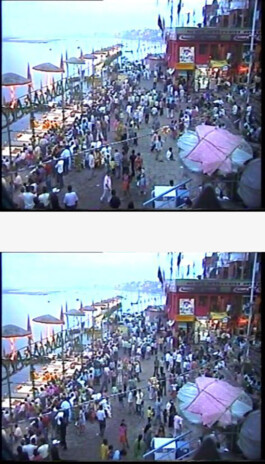
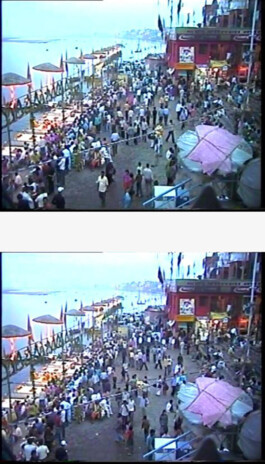


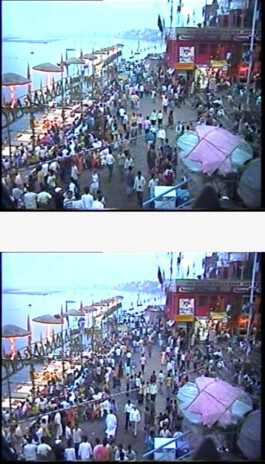

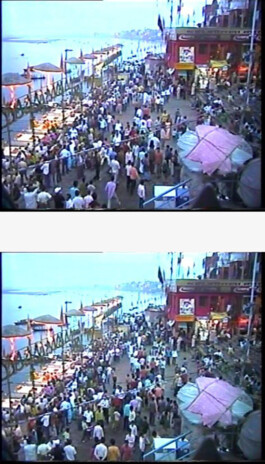
The following three sub-chapters, The Anthem, The Ghat, and The Tourist, are seen as three elements in a tripartite relationship which constitutes the space of Dashashwamedh Ghat. What follows is the start of an iterative process. This will begin with an understanding of a representation of space, followed by a study of the physicality of the Ghat, and then finally the movement and interaction of the body in space.

Thought is not what inhabits a certain conduct and gives it its meaning; rather, it is what allows one to step back from this way of acting or relating, to present it to oneself as an object of thought and to question it as to its meaning, its conditions, and its goals. Thought is freedom in relation to what one does, the motion by which one detaches oneself from it, establishes it as an object, and reflect on it as a problem.(15)
Psychology students will be familiar with the… 18 volunteers from the Stanford student body in the summer of 1971, that inspired endless ethical debate…. After six day, the behaviour of the guards degenerated so appallingly in sadism that the experiment had to be shortened.(16)
As Foucault claimed, individual identity from birth is not a defined human characteristic. In fact, Foucault suggests that humans mould their identity, judgement and personality to the immediate events surrounding them at any time.(17) Therefore, social identity and action, or reaction, resulting from it must be directly correlated to perception.
One such representation has been chosen – the Indian National Anthem. Translated into English, it reads as follows:
Thou art the ruler of the minds of all people,
the dispenser of India’s destiny.
Thy name rouses the hearts of Punjab, Sind,
Gujarat and Maratha.
Of the Dravida and Orissa and Bengal;
It echoes in the hills of the Vindhyas and Himalayas,
mingles in the music of Jamuna and Ganga and is
chanted by the waves of the Indian Sea.
They pray for thy blessings and sing thy praise.
The saving of all people waits in Thy hand,
Thou dispenser of India’s destiny.
Victory, victory, victory to Thee.(18)
The Indian National Anthem serves, within this exploration, as a pathway to understand how social space is used by society, and how space is produced at Dashashwamedh Ghat, within the context of contemporary India and the stratified Indian caste system.
My body is, then, in the aggregate of the material world, an image which acts like other images, receiving and giving back movement.(19)
The National Anthem is one such ‘image’, and thus informs and directs as much as any prescribed guidebook to India. Although the Anthem is not directly perceived at the Ghat, as argued in Caste and Space the narrative it informs within the perceiver is carried to the Ghat; the Anthem is naturally allied to cultural events, and the strong direct referencing of the River Ganges [the word Ganga, meaning River Ganges, is sung in an elongated fashion] in its wording suggests that this representation is at the fore when the visitor to the Ghat understands and interprets space.
Before delving into the anthem itself, what can be said about this type of ‘image’, and how can one attempt to analyse it? The ‘image’ gleaned from the Anthem is as a result of a listening and recollection process of a collection of words set to music and rhythm. However, it would be inaccurate to suggest that the anthem is a song, and therefore should be interpreted as such.(20) Its short, sharp 52 seconds serves to arrest the listener for that period of time only. Just as the nutrients of water take effect on the body long after the process of actually drinking ceases, so too the taste of the Indian National Anthem is not meant to linger on the form of a musical memory – its effect on the body remains and informs long after the music has stopped.
The Anthem demands attention. It cuts through the mundane to act as punctuation over and above that of the everyday. The Anthem starts or ends proceedings, and is held in stasis – never is it an accompaniment amongst the background in any landscape. There is no foreground or background in this scene, just a break in proceedings in which the Anthem is allowed to be perceived, after which there is recommencement of the everyday.(21)
The Anthem also demands participation. Not participation on the basis of its melodious or lyrical value, but on the basis of its loaded political and socialist intension, which it shares with all National Anthems. Participation is compulsory. The common song exists regardless of audience, but the Anthem is without value in an empty arena.
In this respect, the playing of the National Anthem dismantles and creates territories with its refrains and rhythms. Deleuze and Guattari comment upon this extensively and claim that
[T]he role of the refrain has often been emphasized, it is territorial, a territorial assemblage[…] The Greek modes and Hindu rhythms are themselves territorial, provincial, and regional. The refrain[…] always carries earth with it; it has a land (sometimes a spiritual land) as its concomitant.(22)
Deleuze and Guattari go further to suggest that the rhythm brings order to chaos. It can be claimed that this rhythm serves as an ordering device, and thus mimics the mechanism of the caste system. Both devices demarcate space, and both prescribe the manner in which it is to be used. When listening and participating to the Indian National Anthem, what does the ‘image’ speak of with regard to social space and the Ghat? Can the spaces that the Anthem marks out be recognised at the Ghat, and within the physical attributes of the Ghat?
The National Anthem is portrayed as a collective force. Although written and composed by one person, the Anthem is sung by a choir, and not by one singer [in comparison to National Anthems of other nations]. Immediately, the Anthem portrays a sense of communal spirit, but strangely, also of a sense of the ‘us’ as apposed to a ‘me’. Therefore, from the outset, the Anthem also by connection speaks of an ‘us and them’ instead of a ‘me and you’. The notion of ‘us and them’ which is prevalent from the initial verse supplants a feeling of otherness to the perceiver/s, or a feeling of togetherness to the singer/s.
There is no build-up of volume, of voice, or tempo. The choir is introduced within the first second of the commencement of the music. There is a distinct lack of any further addition to this piece, or of any addition of musical merit.(23)
The abrupt shock of the choir cuts through the atmosphere; there is no intermediate or in-between space, just a harsh boundary of ‘them’ and ‘us’, of ‘us’ and the ‘other’. And with the swift introduction, there is no warning of the impending shifting of territory either. No foreshortening of breath and expectation, just a shock of the forceful disjunction of one type of space with another, and then the shock of the realisation of the self in isolation to the ‘other’.
This, however, is a fleeting moment. As swiftly as the National Anthem separates, it tries to join with the social through the means of participation. As Deleuze and Guattari state, refrain and rhythm is a relative concept, and can only be grasped fully when rhythm is seen by the ‘other’, from the outside, from afar. The voice of the choir, set to music, brings with it the sense of participation, for one does have the ability to join and become one with the choir. A swift movement from the perceiver to become part of the ‘image’ can be achieved through participation through singing, by humming, to the tune. But this participation takes away the perceiver’s ability to be outside of the territory of the National Anthem.
As suggested, there is no in-between, only in or out, only a binary condition in body placement. This does not negate or disregard the concept of the boundary, but enforces it. The boundary of territory, the shock of the choir raising their voices is prevalent with another boundary, that of the participation and becoming part of the Anthem. Naturally, this boundary is far less defined for it can be traversed as and when the perceiver wishes to participate [when they wish to join in and sing]. The two boundaries, distinct in their nature and what they guard, bound territories/spaces which are also distinct but linked and overlapping.
If these two types of boundary were labelled, it would serve the purposes of this exploration well, where the language of music is becoming confused with mention of territory, space, and the abstract rhythm – all notional concepts which are glimpsed at but are to fragile to grasp and hold on to. The Anthem Boundary [AB], harsh and abrupt, shares space and territory with the Participants Boundary [PB]. One cannot exist without the other; the PB cannot exist without the AB and one acts as an instigator for the other. Further, the AB cannot exist in isolation; it needs the social activity of participation for it to be validated, for the National Anthem is nothing without the element of the social.
The undecided nature of the PB hangs over the harshness of the AB. The PB is a less of a defined barrier, and its traversal is a gentle affair. In fact, the PB is hardly noticed at all, and it can be traversed many times without the body realising a defined change in sensation, moving from space to space. The change is gradual, as apposed to the definite nature of the AB.(24) Tschumi, when suggesting that bodies violate space, also implies that to violate space one must violate into it, and therefore step into it from another. Thus, the boundary condition is introduced.
[T]here is the violence that individuals inflict on spaces by their very presence, by their intrusion into the controlled order of architecture[…] Architecture, then, is only an organism engaged in constant intercourse with users, whose bodies rush against the carefully established rules of architectural thought.(25)
What is emerging now is in what manner space is fractured, how space is separated, and what effect it may have upon the body.
As the words of the National Anthem resonate above the music, one is clear that it is the rhythm and pace, coupled with words which take precedent over the melody. The instruments are not introduced, nor are they allowed to breathe. The choir and voice leads the direction of the anthem, and that is where the mind of the perceiver is drawn to, there is no escape into an instrumental bridge or interlude.
The song can be read as a glorified cry. The Indian National Anthem is an elaborate cry for help. The cry of voice is the National Anthem. When studying the origins of inequality, Rousseau highlighted language and its complexity, or lack of, as a divisive device across society and its hierarchical organisation. Rousseau delves deeper and suggests that the primeval cry, constant in meaning and symbology across society, portrays the universal feeling of ‘help’ or ‘urgency’.
Man’s first language […] is the cry of nature. As this cry was uttered by a sort of instinct in times of pressing urgency, to beg for help in great danger or for relief in intense suffering, it was not much use in the course of ordinary life, where more moderate feelings prevailed.(26)
Words set to melody sung with force and accuracy by a choir presents to the perceiver, whilst they are listening and not contributing/participating, [as in whilst they have traversed the AB but not the PB], is also a cry for help. A cry which is for the want to an object which is lacking.
What object? What is lacking? And who has been left wanting?
These are seemingly unnecessary questions to answer. The importance of this spatialization process is not to extrapolate the final pieces of a ‘jigsaw to complete a picture’, but to understand that although pieces are missing and questions may arise that need answering, in this instance there is an underlying yearning for an object not in one’s possession. The Anthem is a sharp cry for help in the still darkness.
For 52 seconds, boundaries are vaulted, roles reversed, and givers transformed into the needy. The shock of the Anthem with the choir coupling with rhythm, tempo, and lyric defines territory and, as Deleuze and Guattari suggest, enclose space. Merleau-Ponty states that from sounds,
[W]e discern the appearance of a phrase and, as phase follows phrase, a whole and, finally, as Proust put it, a world. This world exists in the universe of possible music.(27)
Once within the territory of the Anthem, the space and territory of the Indian National Anthem becomes all encompassing and dominant. Space is produced at a pace, and not to a tempo that the participant controls.
We do not possess the musical or sensible ideas […] they possess us. The performer is no longer producing or reproducing the sonata: he feels himself, and the others feel him to be at the service of the sonata; the sonata sings through him or cries out so suddenly.(28)
There is no option for the participant to leave the space which is produced, and which they stand in - the Anthem must run its course, and after the 52 seconds the memory, smell and taste of the space lingers.
The words, per se, are of little importance. In the same manner that the tune of the Indian National Anthem will not be remembered when walking through the Ghat, but instead the ‘image’ from the Anthem which informed a narrative and thus informed the manner in which space was produced, so also, the words of the anthem will not be remembered. What is of import is what they represent.(29)
The National Anthem speaks of “…the ruler of the minds…”, and a Being which is the “…dispenser if India’s destiny.” Further, areas of India are elevated – Punjab, Sindh, Gujarat, Maratha. With the use of a protracted lengthening of syllable, meaning is bestowed upon the River Ganges [the Ganga] more than any other geographical element referenced in the Anthem. Again and again, He is exalted; His name “…echoes in the hills…”, “…mingles in the music of the Jamuna and Ganga…”, is “…chanted by the waves of the Indian Sea…” One assumes that although no direct reference is made, the He being referred to is God.(30) This is further enforced with the allying of a ‘higher being’ to natural geographical features; the land, the hills, the rivers, the sea. The elements of nature have a resonance which cuts through the layers of caste and class, and even economic divide. Tagore has cleverly chosen language which, for 52 seconds at least, unites in meaning across Secular India.
Another result of the tact by Tagore is that the National Anthem shrouds the audience in a layer of myth.
A conjuring trick has taken place; it has turned reality inside out, it has emptied it of history and has filled it with nature, it has removed from things their human meaning so as to make them signify a human insignificance. The function of myth is to empty reality: it is, literally, a ceaseless flowing out, a haemorrhage, or perhaps an evaporation, in short a perceptible absence.(31)
As Barthes claims, myth removes reality to leave an absence where was once presence. Tagore’s intention here is clear and the composer himself was seen to be moving towards an underlying mythical order of elements.
Tagore often referred to the underlying harmony of things in terms of rhythm: he was in no doubt that the rhythms of art […] were a reflection of rhythms of the universe which science could analyse but never communicate.(32)
Reality vanishes and is replaced by the order of rhythm and myth. Space is produced, under the duress of a ‘higher being’ of mythical status. A perception of Godliness seeps into ones narrative, now forever expanding and growing at a pace, and being added to from all quarters.
What is left lingering in the mind after reality escapes is the notion of a boundless land. The concept of space without boundaries, with eternal qualities, contradicts that which has been extrapolated within this study – a space guarded by boundaries traversed first by listening to and then participating with the Indian National Anthem. Although territories and boundaries are already formed, an understanding of Myth brings to the mind the notion of these spaces being overlaid with the conflict of a boundless territory.
From a perception of a representation, the following spaces and territories have been established; the concept of an Anthem Boundary [AB] and Participants Boundary [PB], each with their differing characteristics, enclose space; the notion of a collective body of segregation – not a ‘me and you’ but an ‘us and them’; the notion of a feeling of ‘want’, of a ‘cry’, at the initial point of being introduced to the space; the notion of a boundless territory.
The persons entering the Ghat are familiar with new types of territories gleaned from the Indian National Anthem, and these come to mind and add to those already perceived in isolation on site. A process of not seeking, but recognising these new types of territories and boundaries it initiated. The obvious use of architectural elements and movement through space by people purely based upon function and use is reformed and seen in a new light, and studied under a new lens.
This reinterpretation offers a glimpse as to the manner in which the space produced has informed not only the movement of people, and has been informed by the movement of people, but also the physical architecture itself. Space can now be Casted into groupings based solely not on function, but on inhabitants, use, and character derived from an experience of space and a narrative. This study now seeks to offer a new descriptive interpretation of the architecture of the Ghat, and also wishes to delve into how and why certain architectures in Varanasi manifest themselves in the manner that they do.
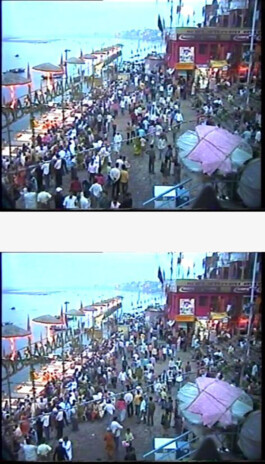
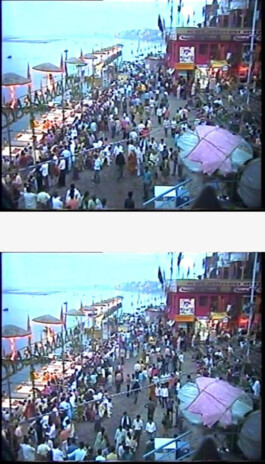


’Older than history, older than tradition, older even than legend, And looks twice as old as all of them put together’ - Mark Twain reflects on Varanasi(33)
After an exploration to extrapolate a sense of space from an abstract representation, this study now shifts its focus from the study of a representation of space, to a study of the space itself; Dashashwamedh Ghat, in Varanasi. The narrative of the Anthem will weave in and out of the physicality of the site, and the manner in which space is deformed and reformed, and produced will be examined. It is the relationships between spaces and territories formed from a perception of the Anthem which will form the basis of this study. A new understanding, and a reinterpretation of the Ghat is the goal of this study, and this chapter marks the point of realisation that narrative coupled with the body produces space.
Within the Introduction, the Ghat was described in the language of a pure physical entity. The possible multiple functions of the steps were described, but not how the act of different castes using the space could change its meaning.
The demographic of the people using the Ghat obviously depends on the immediate climate and holiday seasons. However, what is certain is that approximately 95% of its visitors are Hindu, whilst the remaining 5% can be said to be foreign-born or non-Hindu. Appendix B shows, to scale, Dashashwamedh Ghat as an empty vessel, devoid of social activity. Here, space is represented, but what is not shown is how it is used, and why. As an architectural diagram, the Ghat can be interpreted as a collection of four distinct and functioning entities; the River Ganges, the Steps, the Platforms between the Steps, and the Shops/Stalls.
Effectively, the Ghat seen in isolation is a model of a public square, with all sides bounded by natural or man-made elements to create an ‘open enclosure’. However, the Ghat is one of 80 ghats lining the Ganges and all within close proximity to one another – the effect of a public square diminishes when realising this, to be replaced by a notion that the Ghat is a public domain in a series of linked squares. Thus, and due to the very nature of the steps, the primary route into and out of the Ghat is from its sides – that is, from a direction parallel to that of the Holy River. The Ghat’s head lies on the river, and its feet are pointing towards the commercial centre of Varanasi, to the west.
A secondary route into and out of the Ghat lies in a perpendicular direction to the river, from the west, up the steps and leads to and from the bazaars of the city [Fig. 3.1]. There is no entrance or exit of the Ghat from its corners.
In essence, the primary and secondary routes into the Ghat offer their own contrasting narratives; one follows ghat after ghat and hugs the river, and the other introduces the perceiver to the cultural and religious symbology of the Ghat at the last possible moment after weaving a path through the cafes and bazaars.
Even today, urban space appears in two lights: on the one hand it is replete with places that are holy or damned, devoted to the male principle of the female, rich in fantasies of phantasmagorias.(34)
Although Lefebvre refers to new towns with reference to Modernism, the approaches to the Ghat mimic the duality of two differing narratives to one space.
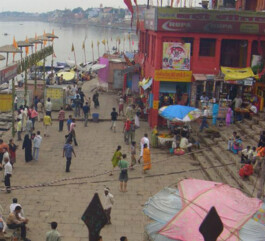
The route parallel to the Ganges

Perpendicular to the Ganges
But after the approach, what of the experience if the Ghat itself? This study will focus on a time interval where the production of space is processed at pace. The 7pm Puja marks a high point for the Hindu and tourist alike, being of both religious and cultural significance. As highlighted within the Introduction, it is at the Puja that a period of activity punctuates the proceedings. The pujas are the only instances of a highly mechanistic and organised action at the Ghat. Half and hour before the start of the puja, low caste cleaners arrive to the ghat to clear debris from the steps [Fig. 3.2], a stage is erected on the lowest step of the ghat, Brahmin priests parade into the space wearing gold robes, and occupy the individual permanent marble platforms which are built on the river bank.
Barriers are erected, Hindu worshippers, tourists, stall keepers gather, and proceedings commence to the sound of devotional songs which blare out from the speakers which, together with the extravagant party lighting [Fig. 3.3] and the marble platforms [and of course the ghat itself] are the only physical representations left at the Ghat when the service is over. Varanasi holds its breath but for these two instances of morning and evening worship to the Goddess Ganga.
Further, the one hour period between 6pm and 7pm is when preparations take place for the start of the Puja. This is when the movement of people is at its most frenetic, and where people from different caste backgrounds filter in and out of the space with a clear direction in mind – to prepare themselves for the ‘set piece’ Puja ceremony. This is when and where Casted Space can be examined.

Cleaners from the Untouchable caste arrive to the ghat to clear debris from the steps
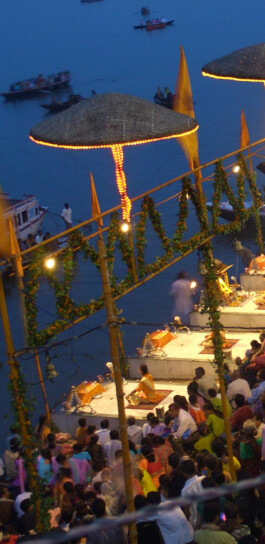
The Brahmins sit under custom lighting stations, and look out to the Holy River
As stated above, there are three entry and exit points to the Ghat; two parallel to the river and one at the top of the steps. Although it can never be stated that the Ghat ‘starts’ at these points [it has already been argued that the concept of the Ghat can be initiated from imagery before even physically entering the space], these three points geographically mark the man-made boundaries to the Ghat. All three points are marked by the presence of members of the Untouchable castes – those who beg for food and money. The highest concentration of Untouchables is by the balustrading at the top of the Ghat steps. During the hour, movement parallel to the Ganges slows, and the flow of people entering the Ghat from the west increases. This brings about the contraction of Untouchable Space from the three points towards the balustrading. The Untouchables celebrate the entry into the Ghat, and the balustrading is their anchor [Fig. 3.4]. Here, the space of the Indian Nation Anthem and the space of the Ghat can be overlaid to reinterpret the relationships between the social and the physical.
The relationship of the start of the anthem, of its opening chords, of entering the space of the anthem with the ‘cry for help’ can be applied to the space produced at the Ghat. It is not sufficient, or productive, to simply suggest that in both the Anthem and the Ghat a ‘plea’ is being cried – but how this sensation relates to other boundaries and territories in both cases is most intriguing. Does the Anthem provide a reason for the members of society most in need to congregate specifically at the start of the Ghat, just as the ‘plea’ is heard at the start of the Anthem? A cry is heard at the start of the National Anthem. A cry is heard upon entering the Ghat. A ‘plea’ is heard upon entering both spaces [Fig. 3.5]. Were these members of the Untouchable caste in part informed to reform the steps and balustrading into a territory after perceiving the Anthem? These spaces are bounded by the Anthem Boundary [AB], as extrapolated from the National Anthem, and recognised at the Ghat.
Not only are spaces reformed [the entrance to the Ghat is now reinterpreted as a congregating area, not a space of transition] but also the functions of architectural element take aboard new functions. The balustrading, as mentioned above, forms an anchor for the Untouchables, and is made redundant as an aid to traversing the steps [Fig. 3.6].
The gradient of the steps themselves is at approximately a 40 degree angle from the horizontal. This level of steep incline with no balustrade assistance results in a rather peculiar scene – instead of people walking straight up and down the steps [in a direction perpendicular to the river], a ‘zigzag’ motion is adopted in an attempt to soften the harsh gradient. The route to the destination, be it to the top or the bottom of the Ghat, is thus elongated and lengthened as a greater distance is travelled in the journey.

The Untouchables ‘hug’ the balustrading at the steps

The Untouchables ‘plea’ for food at the entrance to the Ghat

The blue balustrading is no longer an aid to traversing the steps
Is there a notion of ‘us and them’, as witnessed in the Anthem, and does this reform and inform the production of space at the Ghat? Clearly, this study is drawing upon the concept and reality of a segregated society, and therefore the idea of divisive elements is strong within the case study. However, at the Ghat this concept is intensified to the point where the use of space is altered.
At the start of the Puja, the marble daises are the sole domain of members of the Brahmin caste [Fig. 3.7]. The flat marble platforms share their architectural features with the platforms between the steps at the Ghat, and thus it can be suggested that the space of the dais is evident not only at the dais, but also at certain areas throughout the Ghat. Their domain stretches beyond its physical confines, and Brahmic Space is elongated. Does this explain why, as 7pm approaches, there are less and less Middle Caste members standing and sitting on the platforms between the steps? Of course, members of the public and tourists congregate on the stagger of the steps to get a view of the Puja service below, but the flat surface of the platforms provide ample, and arguably more comfortable, space to see the Puja from. Why linger on the steps and not the flat surface when the steps are, even through the service, being used as a thoroughfare to enter and exit the ghat?
The ‘us and them’ concept from the Anthem is transplanted across the entirety of the Ghat, and is manifested in the manner in which members from the Middle castes only watch the Brahmins perform from the steps and not from the flat platform surfaces – even though the platforms between the steps are completely vacant. A glimpse of Brahmic Space is perceived even in an area where no members of the Brahmin caste stand. The Anthem informs space and caste organisation in subtle ways, where it is not only society that castes space, but also the association of architectural elements to a specific strata of society.

The marble daises are the sole domain of members of the Brahmin caste. Nobody else is even allowed near them.
Allied to the notion of separation and ‘collective segregation’, the Indian National Anthem portrayed a sense of boundless territory. At the Ghat, the most obvious, clichéd and romanticised ‘scene’ for this to be recognised would be that of the view across the River Ganges, to the opposite planes. But this is not the case.
The eye, as it jumps over the Brahmins sitting on marble, is interrupted by the boats on the river. The boat rider’s focus too is on the Puja, and the concept of boundless territory is not found – instead what is found is a mirror, and the boatmen copy one’s own attraction to the Puja, and visa versa. There comes a realisation that the Ganges is not the purpose of ones visit to Varanasi, it is the Brahmins on their stage. There is no view over the River and beyond the Brahmins to the horizon. It is empty. Instead, the view is cut short by the riverbank.
Desert, and deserted, sand planes greet the eye on the opposite bank, together with a sense of emptiness [Fig. 3.8]. However, where there is unbounded development is across the bank of the Ganges, in a direction parallel to the river. The notion of the separation of spaces, of the steps and platforms, continues unabated in a regular rhythm. One cannot suggest here that the reason for this sideways development is because if the narrative informed from listening to the National Anthem.
But, the repetition of ghat after ghat after ghat, and the development of commercial/cultural events and architectures which occupy each ghat give the impression of an infinity being witnessed [Fig. 3.9]. A repetition of a repetition, and of a territory unbounded. What is alarming is that Lord Shiva’s Ganges, forever flowing from his locks of hair, is not where the romantic infinity is to be found. The infinity is to be witnesses with one’s back to the river, and looking left or right at a scene repeating itself again and again. The notion of Godliness as perceived is remembered in a man-made form.
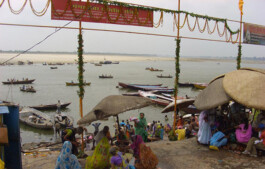
A severe lack of activity and development on the opposite side of the River Ganges.

Unbounded development along one side of the Ganges. The space of the Ghat is repeated as far as the eye can see.
The sense of a PB gleaned from the Anthem, and the concept that there is territory which pierces through the backdrop of a scene, which has an undefined edge [in relation to space bounded by the AB and occupied by members of the Untouchable caste at the entrances to the Ghat], can be recognised at the Ghat. The relation within the Anthem between the AB and the PB was that of one having a fixed territory, and the other more fluid in its nature with an undefined and temporary edge condition which cannot be grasped, even if the memory of its presence lingers.
This PB manifests itself in the territory and space created by the procession of the Brahmins entering the Ghat in a line, prior to the start of the Puja ceremony.
Their entry into the space is of their own accord, and is defined by an event which they control. Their exit is under the same conditions. Although there is no set ‘formal’ route into the Ghat for the Brahmins, they always enter in an ordered line, and then align themselves with the marble platforms [Fig. 3.10]. With one platform for one Brahmin, the architecture of the Ghat is succinctly related to that of the body.
The Brahmin has a relation to the architecture and rhythm of the Ghat which is without compromise. This mimics the manner of the relationship between the Participant of the Anthem, and the rhythm of the Anthem itself; it is again without compromise as the Participant, in order to participate, must partner and align themselves exactly with the tune/rhythm/words of the Anthem. The Brahmin, in order to perform at the Ghat, must also tune and align themselves exactly to the architecture of the Ghat. Any compromise [two Brahmins to one platform, for example], would be instantly noticed and seem ‘out of tune’ with proceedings.
After the ceremony, the Brahmins leave, leaving no trace other than the marble daises at the waterfront, and the daises are left vacant. These act as a memory of their presence, but more pertinently as the only piece of architecture at the Ghat which is functioning solely as it was intended. The steps, the platforms between the steps, the boundary walls, and the balustrading all perform primary as well as appropriated functions.
However, the marble daises are the only piece of architecture that perform one, and only one, primary function. They serve more as a signifier to an event [for 22hrs of the day], than as a functioning architecture [for the two, hour long Pujas in the morning and evening]. As with the Anthem, the moment of participation is fleeting [always less than 52 seconds], however the resonance of the memory remains.
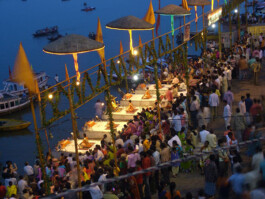
The Brahmins are ‘aligned’ to the space of the Ghat. One Brahmin for one platform – there is no compromise.
The Ghat has attempted to reinterpret the history of Dashashwamedh Ghat to find reasons as to why its architecture and implied functions of elements of architecture have been subverted in a contemporary setting. In addition to narratives formed, one of which was examined in The Anthem, the constant presence of the tourist in Varanasi adds a further layer of interpretation on the physical space – an interpretation of space outside of that gleaned from a perception of the Indian National Anthem. Whilst still concentrating on the physicality of the Ghat, this study now shifts its focus to that of the perspective of the Tourist. Does caste, and now Casted Space, inform the Tourist?

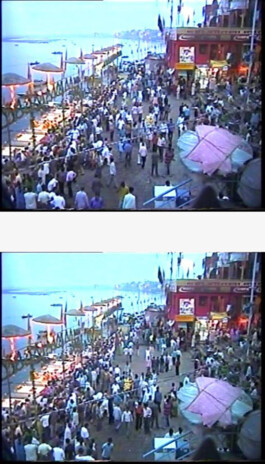


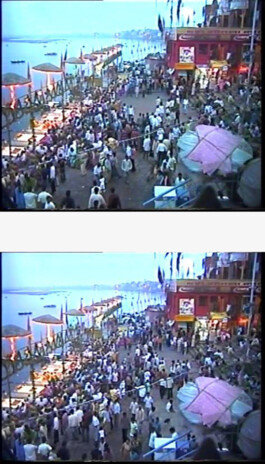


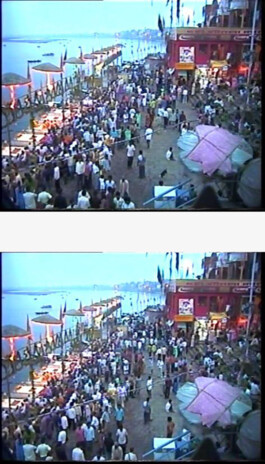
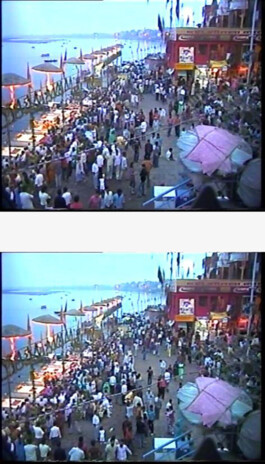
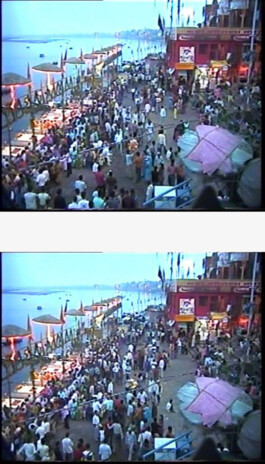
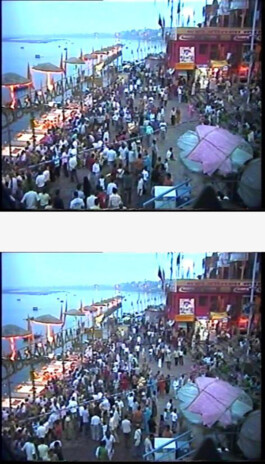
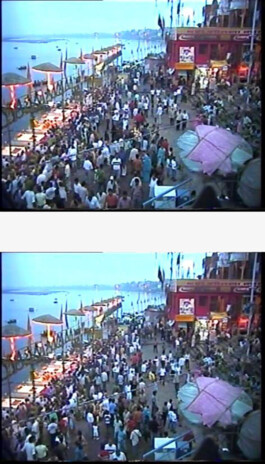
It’s good to give people space(39)
Amidst a backdrop of caste variation and associated social performance, another defined, yet more contemporary, caste is pushed into the space of Varanasi. The modern traveller, with Lonely Planet guidebook in hand, pulls international tourism to Varanasi.
It’s a magical city where the most intimate rituals of life and death take place in public on the city’s famous ghats. It’s this accessibility to the practices of an ancient religious tradition that captivates so many visitors.(40)
The sense from the authors of the Lonely Planet Guide that ones visit to India is not complete without a visit to Varanasi compels the tourist to seek out the sights and sounds as portrayed in the guidebook. The Tourist’s perception is informed and prescribed before setting foot on foreign land.
The process of representing tourist space is continued, construing a hermeneutic circuit in which tourists contingently (re)produce representation of tourist space as well as consuming them.(41)
Thus, just as perception and social interaction for the tourist is informed and nurtured from circumstance of birth, subsequent education and access to representations of space, all castes perform in space according to their defined narratives.
[P]eople are guided to act in certain ways and not others on the basis of the projections, expectations and memories derived from a multiplicity but ultimately limited repertoire of available social, public and cultural narratives.(42)
Every space is ‘loaded’, and there can be no finite representation that ‘fixes’ space to one definition of use or meaning.
Edensor, in ‘Tourists at the Taj’, writes extensively about how tourist space, which is but one layer of understanding and interpretation of the Ghat, is regulated and organised. Edensor draws upon Foucault’s notion of a heterotopia to examine how tourist space us either fixed of in flux, organised or fluid in nature.(43) Edensor goes further and uses the metaphor of a ‘performance’ for an examination of tourist practices.(44)
That the Ghat is both a chaotic and organised space where a performance is being witnessed is not in doubt. However, now that abstract spaces and territories have been established, how does a perceiver outside of the realms of the narrative formed by the Indian National Anthem respond to this spatial organisation? Simply, how does the tourist perceive the space of the Ghat which has been informed by a representation and narrative outside of their confines?

The tourist eagerly first approaches the boatmen, and then negotiates a price for boat ride

An experience not to be missed by Lonely Planet readers
The tourist to Varanasi typically stays for two to three nights only, with the Puja experience being one of the main reasons to visit the city. Although the tourist season remains throughout the whole year, the length of stay for a single tourist is fleeting. Between the 15th and 16th of June, 2008, short interviews were conducted with tourists arriving at the Ghat for the first time.
The purpose of these interviews was to examine where the tourists felt most comfortable standing/sitting when witnessing the 7pm Puja.
Here are external images. I see plainly how external images influence the image that I call my body: they transmit movement to it.(45)
If, as Bergson claims, the image causes the body to move, where does the tourist move to after perceiving the palimpsest of layers and images at the Ghat? And, how does the caste structure, notably the Untouchable caste, respond to this?
When asked the question: “When you entered the Ghat for the first time to see the 7pm Puja, where did you end up standing for the ceremony?”, the following responses from tourists were recorded.
Olivia, 24, from Switzerland: “I don’t really know where I stood. At the front(46) really. Not too far back.”
Mark, 38, from Slough: “I stood near the front on the first occasion. Near the Brahmins, but not too close.”
Unknown female tourist, from Japan: “In my culture, we like to give others, like, some space, some respect. I stood near the front, but not too close to the Brahmins, because I was not comfortable getting too close.”
Mark and Sarah, 24 and 23, from Reading: “ Just got in near the front steps. Good view of the Puja. But not too close to the River, as we didn’t want to disrupt the ceremony. We just wanted to take good pictures and feel the atmosphere.”
Alistair, 34, from Scotland: “I like to see practices from the view of a number of realities.”
Author: “Um, what do you mean?”
Alistair: “I didn’t stay in one place too long. I moved about, but near the front, near the river and the Brahmins.”
When asked where they entered and exited the Ghat, nearly all responses were identical; parallel to the River Ganges and never from the west. And finally, when asked: “You obviously saw the Brahmins dressed in bright yellow and orange, but did you notice the Untouchables at the top of the steps?”, the responses were as all negative. None of the tourists looked behind them to the top of the steps to notice the members of the Untouchable castes crowded around the balustrading.
Olivia: “Really? I saw a few when I entered, but I didn’t look up.”
Mark: “Oh, I must have had my back to them. We were facing the Brahmins and the Puja, and then left the same way that we came.”

From the highest point of the Ghat, the Untouchable holds visual grip of all proceedings
The space of the tourist is caste all around the Ghat, for the Ghat is there to be consumed for cultural gratification. The tourist body, however, is drawn to the Puja. Obviously, the Puja and the Brahmins are the main ‘draw’ of the Ghat, and the tourist yearns for the chance to legitimise their trip with a close encounter with a cultural event, and the members of society that facilitate that event.
The concentration of Tourists at the front of the Ghat, nearest the Brahmins, suggests firstly a notion of Tourist Space, and secondly the connection of this territory to the PB – for in the manner in which the Brahmins align themselves with the daises, also the Tourist aligns themselves with the Brahmins. Without the Anthem, there is no Participation. Without the Brahmin, there is no Tourist experience at the Ghat.
Interestingly, this brings the concept of control and ownership of space into the study.
Those who produce space [Absolute Space] [peasants of artisans] were not the same people as managed it, as used it to organise social production and reproduction; it was the priests, warriors, scribes and princes who possessed what others had produced, who appropriated space and became its fully entitled owners.(47)
Lefebvre asserts his view on ownership within a European historical context. However, a parallel to how space is owned, or how space is commanded, by sections of society at the Ghat can be drawn. With no fiscal values attached to social cultural interactions between castes, how is ownership to the valuated at the Ghat? The Brahmins ‘control’ the event and space of the Puja, but can Lefebvre be contested and questioned? Do the ‘high’ castes and Tourists really own the space? If surveillance, and the control of it, is a key element of the power and hierarchy of spaces and society(48), as argued by Foucault, the assertion that the higher castes own, or hold dominance over the lower castes, can be argued against.
The lower castes, the Untouchables, from their vantage point oversee the proceedings below, even through they are not a part of them. Why do the Untouchables not go down to the front where the tourists are, and beg for money and food? Why not congregate in an area of high people flow, instead of clinging to the balustrading at the entrance [start] to the Ghat, and at its most elevated point?
Here, the narrative stripped from the National Anthem informs the body and produces territory in a most alarming manner. The Tourist seeks the spectacle of the Brahmins, but Lefebvre is defied. The Untouchable holds a visual grip [Fig. 4.2], and therefore ownership, on proceedings due to their positioning at the start of the Ghat space.
And, as argued, the positioning of the members of the Untouchable castes can be said to have been informed, in part, by the perception of the Indian National Anthem.
At the Ghat, and specifically leading up to and during the Puja, the National Anthem has temporarily sacrificed the human condition for need, and replaced it with the want of power and control of the Brahmins, Middle castes, and Tourists. The caste hierarchy is reversed, and the Untouchable is King for an hour.
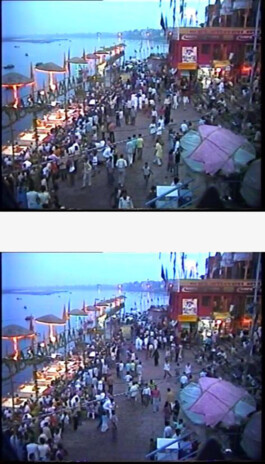
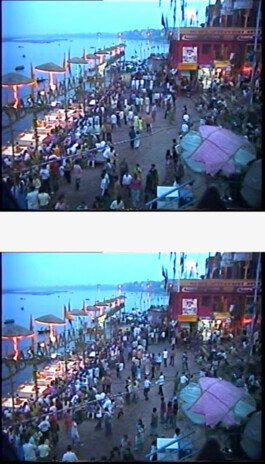
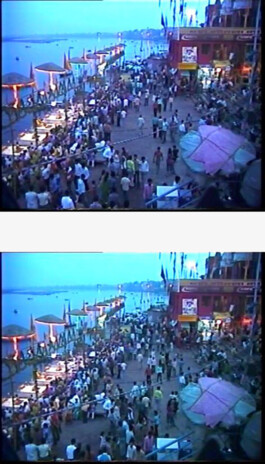
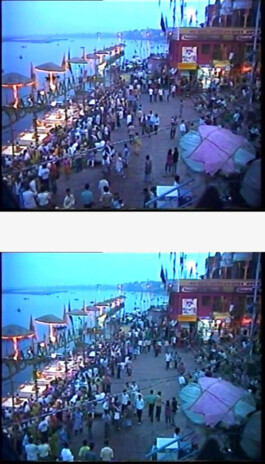
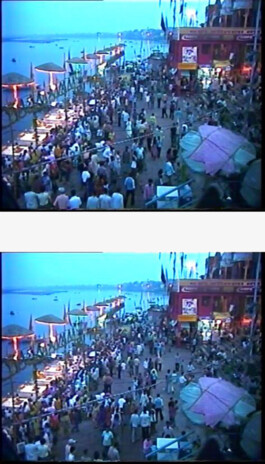


[W]hatever be the inner nature of perception, we can affirm that its amplitude gives the exact measure of the indetermination of the act which is to follow. So that we can formulate this law: perception is master of space in the exact measure in which action is the master of time.(49)
This final chapter allows for a moment for pause and reflection upon what has been written about the study into Caste and Space. The object of this exploration has been to understand how the Caste system in India can and does inform how physical space is used, and also reforms the use and functions of architecture to assume roles for which it was clearly initially not intended.
This dissertation began by introducing the Indian Caste system in the chapter Caste and Space. A brief history of the stratification of Indian Hindu society underlined how specific spaces could hold multiple functions according to personal narratives and which caste one belonged to. Through an understanding of perception, and the role that narratives have in suggesting how space is perceived and used, the Indian National Anthem was taken as a cross-caste representation of space, and examined to extrapolate how differing castes could perceive and use the space of Dashashwamedh Ghat in Varanasi, India. In essence, the Anthem was appreciated within this study as a subliminal ‘guidebook’ to the Ghat.
The chapter Dashashwamedh Ghat was divided into three major sub-chapters. The Anthem conceptualised the Indian National Anthem as an architectural manifesto and sought to extrapolate from its perception a notion of spaces, boundaries and territories. Through the process of listening and participating in the singing of the Anthem, it was argued that when entering the Ghat at a later time, the body would respond to spaces in a manner which had been tainted by the Anthem. The significance of studying the Indian National Anthem as the representation of space was that it is one of the few representations in India which traverses cross-caste boundaries. The Anthem is readily available to all members of the public, and is performed at all state/cultural gatherings, as well as in school, on television, and at cinema film showings. The Anthem as a representation of space is caste over the citizens of India.
The sub-chapter The Ghat sought to recognise territories and boundaries gleaned from the Anthem, in physical space. A reinterpretation of the architecture of the Ghat, and around the Ghat, unveiled a new meaning of the steps and balustrading, the areas where different castes congregate, and the development on the riverbank and across the opposite bank of the Ganges.
The sub-chapter The Tourist introduced another layer of representation and reformation of physical space into the study, and discussed how the territories and boundaries recognised at the Ghat could inform the perception of the Tourist. This chapter brought about an interesting perspective on the ownership of the Ghat, and reversed the common notion of the ‘higher’ castes controlling space. In effect, The Tourist sought to subvert and nullify the concept of a hierarchical caste structure [of high/middle/low castes] to suggest that all castes produce space, and all castes, at some stage during the day at the Ghat, can conceptually assume a dominant station over and above others. The Untouchable being the ‘higher’ caste during the Puja is an interesting notion, and contradicts common thought based upon traditional non-narrative theories of caste structures.
There is, as always, the scope for further thought on the subject of caste and space. The avenues discovered but not traversed in this dissertation amount to at least as much in number, if not more, than the ones explored. The notion of place and memory with reference to perception was severely undertreated. If Bergson’s adage that
There is no memory without perception
was fully adopting into this discussion, this dissertation would have undoubtedly changed complexion. The process of finding and then comprehending all narratives that inform the perception of space could continue unabated. Only one such narrative was discussed in this study - in no way is one suggesting that the space at Dashashwamedh Ghat consists of only the entities defined in this dissertation. However, the purpose of this dissertation has not been to solely highlight spaces from one representation of space, and to describe them. It has been to show that spaces do exist and that the members of different castes can change the function, use and perception of these spaces in starkly different ways.
The examination of different castes could also be extended to more than were studied within this exploration. The case study methodology highlighted instances where this study has struggled to cope with the complexity of the subject matter. The idea of caste structure in India is close to a taboo subject, and a realisation of this by the author led to a somewhat simplified identification process of caste members. A thorough study of the main practising castes in contemporary India would need to be undertaken to fully comprehend what is truly a complex subject. With this knowledge, a more rigorous study of people movement could be undertaken at the Ghat.
Also, a more stringent method of interviewing members of the public within a ‘foreign’ setting, as using prescribed ethnographic techniques, could have been incorporated when conducting the field research. The difficulty of approaching and questioning members of public, especially members of the Untouchable castes, was a task fraught with uncertainty, and at times seen as a threatening act to the interviewees. The involvement of an Indian guide only partly alleviated this problem.
Further work could involve the study of spaces which are used by all members of Indian society, but have less of an obvious cultural undertone. An airport or railway station, for example, could provide an interesting setting for a study into how these spaces can also be reformed to assume new functions and attributes. A furthering of this dissertation would be to undertake a repetition of this type of study but in different settings, in order to uncover alternative architectural histories.
It has never been the intention of this dissertation to question why the segregation in Indian society occurs, or why, say, the Untouchable does not perform a blessing at a Puja ceremony. Much of what has been described during the case study period can be said to happen because of religious/traditional/cultural or pure practical/logistical reasons. However, it can also be stated that there are, and must be, other reasons for the architecture at the Ghat to be reformed and utilised in a unique manner. It is the questioning of the idiosyncrasies at the Ghat, over and above those that have been written about at length in guidebooks and Varanasi documentaries, which has driven this study. To search for a reason – an alternative reason – for the production of space at the Ghat with a reference to the narratives of members of all castes, including the Tourist, has been an aim of this dissertation.
As mentioned within the Introduction, the study of space with a reference to caste segregation in contemporary India has not been attempted before within an academic environment. The implications of this study, as well as offering a new interpretation of the history of the Ghat, has more far reaching significance. Traditionally, ‘Holy’ spaces, such as the Ghat, should be welcoming to all members of the public regardless of caste or background. This is one characteristic that makes them ‘holy’. This is clearly not the case as any visitor to Varanasi will proclaim. It has been argued that the Ghat is not so much a social-levelling device, but allows for the transferral and shifting of castes across a hierarchy.
This new understanding of castes and social activity suggests a novel appreciation of how the language of architecture can be subverted by society and castes, and how cultural events can bring about a further shift in the perception of physical elements. Space may change according to movement through it by the body, but it is only now that the idea of the ‘body’ has been extended to the reality of the caste system. The ‘body’ therefore, is now seen not as a single concept, but now a string of concepts based upon a birthright.
This study has the scope to suggest that all spaces can be seen as Casted Spaces, and so future spaces could be understood and designed for in a manner to reflect this. Untouchable Space in a playground? The notion of the Anthem Boundary in an office? Or the idea of a ‘plea’ at the entrance to, say, a stadium? Further, spaces outside of an Indian setting could also be Casted, if the representation of space is relevant to the members of society under scrutiny.
This dissertation has highlighted that although in the harshest of circumstances, ones social standing can be fixed at birth, the intricacies of social interaction and subsequent reformation of architecture betrays the hierarchy of caste systems. The production of space is a fluid concept, shifting according to use and time. It maybe that caste is a fixed entity, but caste in space, and Casted Space, is forever in flux.